
Search experiences increasingly use AI to assemble answers, from ChatGPT Search and Google's AI Overviews and AI Mode to Microsoft Copilot.
As a result, we expect more businesses to ask: “We appear in Google Search, so why are we hardly ever cited by AI?”
One of the first ideas that comes to mind is GEO: Generative Engine Optimization.
You might wonder whether you need an llms.txt file, special schema for AI, or a rewrite of your content specifically for ChatGPT.
But there are things to check before that.
For a page to be used in AI search, it first needs to be discovered, understood, and judged useful for the question being asked.
In other words, the issue may lie in the site's structure and information architecture, rather than simply in “SEO for AI.”
AI search looks for evidence behind an answer, not just pages
Traditional search has largely focused on deciding which pages to show in response to a question.
Search powered by generative AI adds another important question:
“Which information can serve as evidence for answering this question?”
Google explains that AI search still uses its regular Search index and ranking systems. When needed, mechanisms such as retrieval-augmented generation (RAG) and query fan-out gather information through multiple searches related to the original question. [1]
Microsoft makes a similar distinction: traditional search focuses on which pages to show users, while AI grounding asks which information can responsibly support an answer. [2]
This is a significant difference.
Consider a question such as: “I want to redesign a B2B website in Tokyo. I need a company that can help with UX, implementation, and web analytics.”
AI does not have to rely on a single search term such as “web design company Tokyo.”
It can look for information about B2B experience, UX, development, GA4, past work, and location, then combine those elements into an answer.
In that situation, ranking highly in search and being useful as evidence for part of an answer are not the same thing.
When you do not appear in AI search, separate four possible problems
“We do not appear in AI” is not enough to identify the cause.
In practice, we find it more useful to distinguish at least four stages.
1. Crawlers cannot access the site in the first place
The most basic question is whether a crawler can access your pages.
This is not just about robots.txt. CDN, WAF, bot protection, and firewall settings can accidentally block search crawlers and AI-related crawlers as well.
For ChatGPT Search, OpenAI advises public websites not to block OAI-SearchBot if they want their content included in search summaries and citations. [3]
Stronger security alone is therefore not the answer. You need a design that blocks malicious bots while allowing the crawlers you need.
2. The information exists, but its relationships are unclear
Another common problem is that information exists without being organized clearly across the site.
A creative portfolio, for example, might show a client name, finished images, mockups, and a button to view the work.
That may communicate the quality of the design to a person. But a machine may still struggle to understand:
What was requested? What did you handle? Was the work web design, UI/UX, or implementation as well? Which market did it target? What problem did it address? What was the result?
Bing's AI search guidance recommends reducing ambiguity and ensuring that text, images, and video consistently describe the same entity, product, or concept. [4]
This does not mean adding more words for their own sake. It means explicitly stating important information that a person might otherwise infer from looking at a screen.
3. The content is accurate, but almost identical to other sites
Even without a technical problem, your content may be unlikely to attract citations if it is too generic.
“Five benefits of having a website,” “Why UX matters,” and “Seven web design trends for 2026” are not necessarily inaccurate.
But similar information exists on thousands of sites. Generative AI can also summarize content at that level in seconds.
In its 2026 AI search guidance, Google explicitly introduced the idea of non-commodity content. [1]
Rather than simply repackaging existing information, it recommends offering value that other pages or generative AI cannot easily reproduce: firsthand experience, original analysis, specialist perspectives, and primary information.
For example, “What we learned from 90 days of GA4 and Clarity data before launching a B2B campaign” is more likely to contain information unique to a business than “Ten ways to improve a landing page.”
Data. Decisions. Failures. Comparisons. Processes. Results.
As AI search grows, the value of information grounded in actual experience may increase rather than diminish.
4. Your website and external information do not agree
When AI tries to understand a company, the company's website is not necessarily its only source.
Business profiles, Bing Places, industry directories, social media, external articles, and reviews also provide information.
If the company name, location, services, opening hours, and URLs are inconsistent, it becomes harder to understand the business as an entity.
For local businesses in particular, Bing recommends keeping addresses, opening hours, and contact details current, and using Bing Places to maintain accurate information. [4]
Google also identifies keeping Business Profile information up to date as a Search fundamental, including for AI search. [1]
Again, the priority is not to create large amounts of special information “for AI.” It is to make sure the information you have already published does not contradict itself.
Do you really need the “special measures” often discussed in GEO?
As AI search has gained attention, terms such as GEO and AEO have become more common.
This is a developing field, so there is no need to dismiss everything. However, Google's official guide published in May 2026 explicitly rejects several misconceptions.
For Google Search, you do not need to create an llms.txt file.
Google says it does not use this file for Search, and that adding it has neither a positive nor a negative effect on visibility or rankings in Google Search. [1]
You do not need to divide your writing into small “chunks” specifically for AI, either.
Google says there is no need to break content into small fragments merely to help AI understand it, and there is no ideal page length. [1]
There is also no special schema just for AI.
Structured data remains important, but there is no special Schema.org markup required for inclusion in AI Overviews or AI Mode. [1]
Structured data is not a magic setting that makes AI choose your page. It is part of Search's basic infrastructure for clearly describing relationships such as organizations, articles, and breadcrumbs.
Thinking about GEO is not itself a problem. Treating GEO as a collection of tricks for gaming language models is.
SEO is the foundation, but rankings alone are not enough
Does this mean traditional SEO is no longer necessary? Quite the opposite.
Google explains that AI Overviews and AI Mode build on its existing Search ranking and quality systems. A page must be indexed in Google Search and eligible to display a regular snippet to appear in these AI features. [1]
Microsoft similarly explains that AI grounding builds on traditional search infrastructure rather than replacing it. [2]
Adding GEO alone will not solve fundamental problems with indexing, canonical URLs, internal links, JavaScript rendering, sitemaps, duplicate content, or page experience.
However, having the SEO basics in place does not automatically mean AI will cite your site. This distinction matters.
Being indexed in Search is roughly equivalent to “we know this page exists.”
To be used in an AI answer, the page must additionally be judged “worth using as evidence for this question.”
Google itself states that meeting technical requirements and best practices does not guarantee crawling, indexing, or inclusion. [1]
Turn your business website into information that can be cited
When thinking about AI visibility, we find it more useful to see a website as a collection of verifiable evidence about a company, rather than a place to put keywords.
For B2B websites in particular, the following sequence helps separate possible problems.
- Can crawlers access the site?
Check robots.txt, WAF/CDN settings, bot protection, and JavaScript. - Are important pages indexed correctly?
Check Search Console, Bing Webmaster Tools, canonical URLs, and sitemaps. - Is the company's identity clear?
Be specific about location, markets served, services, expertise, and scope of responsibility. - Are services explained concretely?
Go beyond abstract brand messages: explain what you provide, to whom, and how far your service extends. - Does your portfolio contain more than images?
Describe the challenge, your role, decisions, process, and results where relevant. - Is there information only your company could write?
Document firsthand experience, original data, comparisons, failures, and methodologies. - Is external information consistent?
Align basic details across Business Profile, Bing Places, social media, and directories. - Have you left outdated information online?
Update services, prices, staff, technology, statistics, opening hours, and other information that changes over time. - Are you actually measuring visibility?
Use Search Console and Bing Webmaster Tools instead of assuming that your site “should appear in AI.”
This sequence shows that much of AI search optimization extends existing work in SEO, information architecture, content strategy, branding, and analytics.
That is why we consider “making a website whose information can be understood correctly, including by AI” more practical than simply “adding GEO work.”
AI visibility is finally becoming measurable
Until recently, AI visibility had a major problem: there were very few ways to measure it.
Repeatedly typing your company name into ChatGPT or Copilot and checking “we appeared today” or “we did not appear today” was not enough to provide a useful operating metric.
This changed significantly in 2026.
In February, Microsoft introduced AI Performance in Bing Webmaster Tools. It lets businesses check how often their pages are cited, which URLs are cited, and which grounding queries reference them across Microsoft Copilot, Bing's generative AI answers, and selected partner experiences. [4]
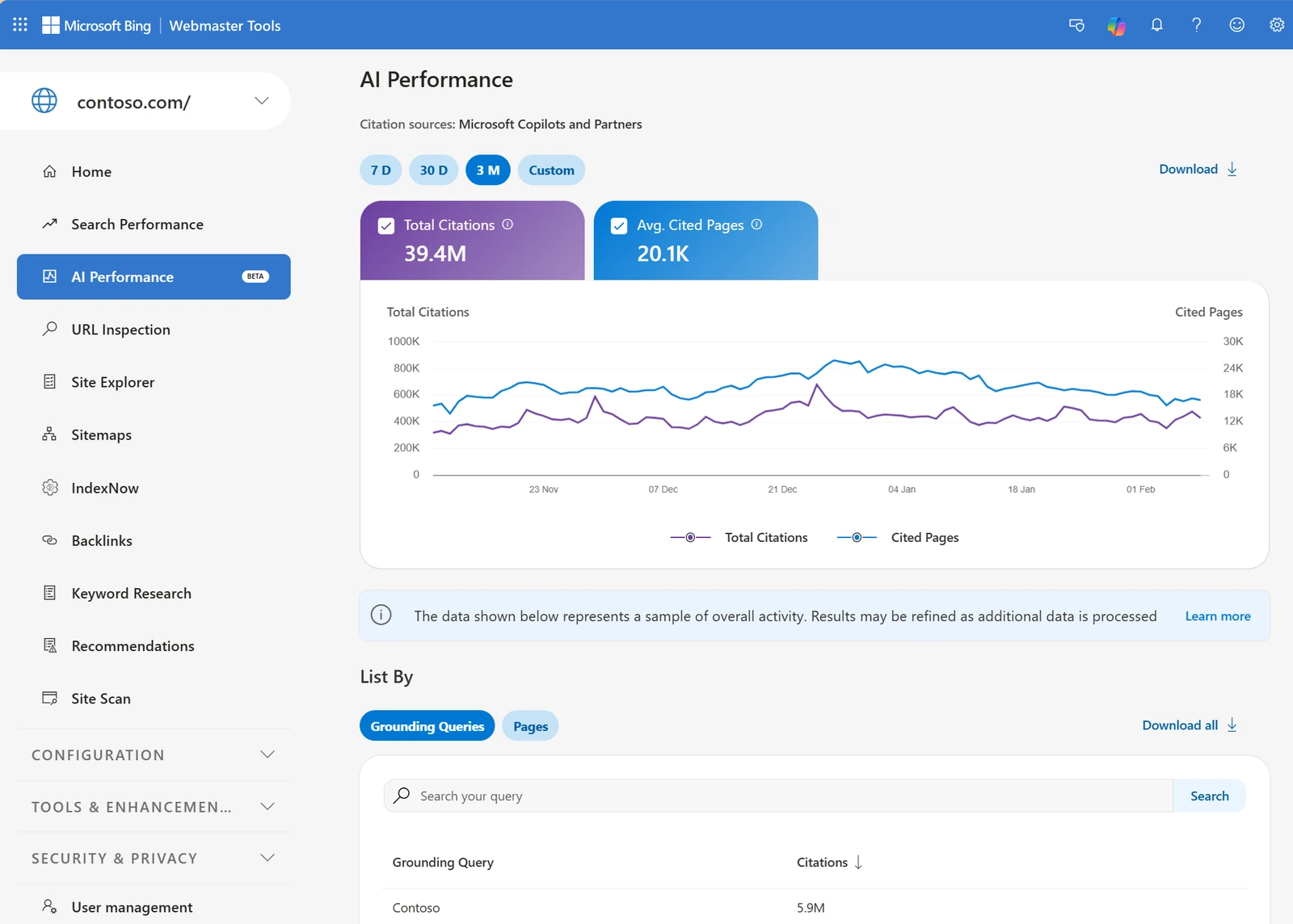
In June, additional analysis features were introduced, including Intents, Topics, Citation Share, and Compare. [5]
Google also announced the Generative AI performance report in Search Console in June and rolled it out globally on August 31. It shows which pages appeared in experiences such as AI Overviews and AI Mode, with dimensions including impressions, country, device, and date. [6]
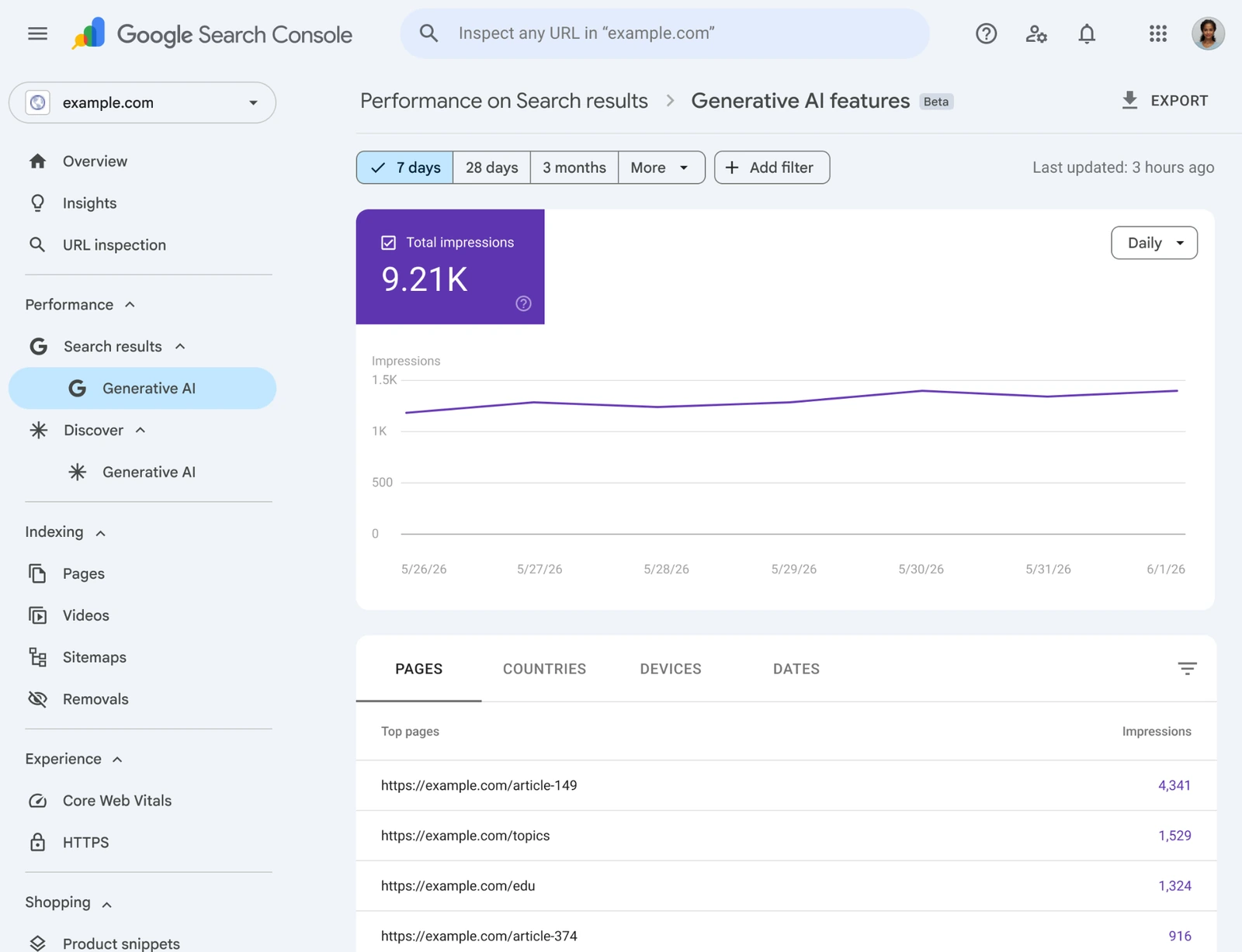
In September, Search Console also began offering dedicated analysis for multimodal searches involving images. [7]
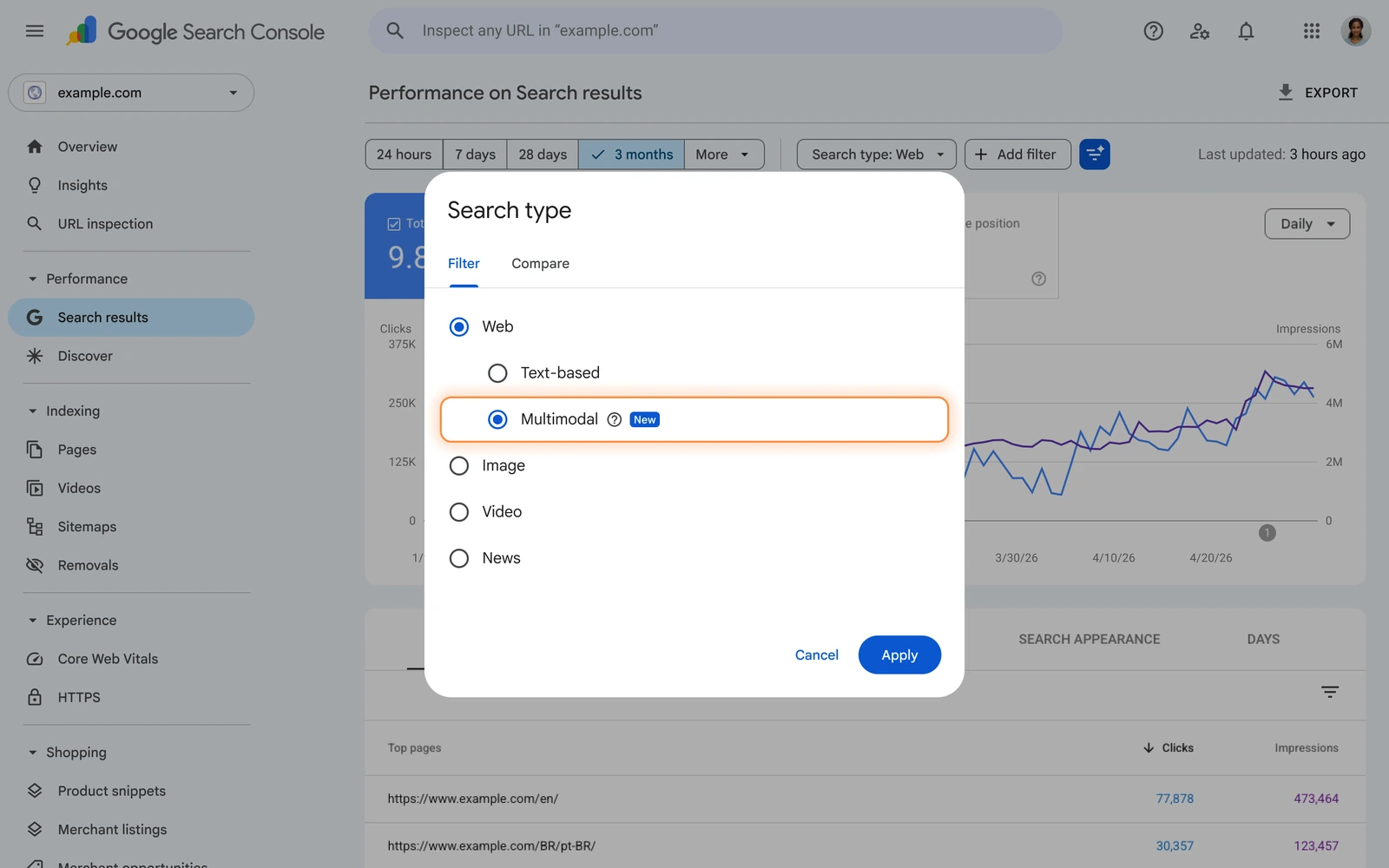
In other words, “Do we appear in AI?” is gradually becoming a measurable question: “Which information is being used, in which AI experiences, and in what way?”
However, visibility and traffic must be considered separately.
A brand or page being used in an AI answer does not necessarily lead to a click.
Someone may learn the company name there, search for the brand later, visit LinkedIn, or return through a different channel.
Judging AI search only through the traditional “impression → click → session” sequence may overlook some of its effects.
Conclusion: create reasons to be chosen, not just ways to be seen
If your website does not appear in ChatGPT Search, AI Overviews, AI Mode, or Copilot, you do not need to start by adding llms.txt or rewriting every sentence for AI.
First, check whether AI can access the site; whether important pages are indexed; whether the company and its services are explained specifically; and whether your portfolio offers more than images.
Look for experience and information that cannot be found elsewhere. Check consistency with external information, update outdated content, and make sure you can measure what is happening.
Adapting to AI search is not a task that can be completed with a special plugin or a single setting.
We see it as the result of connecting SEO, web architecture, content, brand, reputation, structured data, and analytics to make a company easier for both people and machines to understand.
In SEO, we have traditionally asked: “Can Google find this page?”
Now we need to add another question:
“When AI finds this page, is there a reason to choose it as evidence for an answer?”
That may be the most important question when thinking about AI visibility.
If your site is rarely cited in AI search, or you would like to investigate the causes across SEO, site structure, and content, share your current website and concerns with Go 5tudio. We can assess whether the work falls within the scope we can support.
References and official information
Official sources checked on October 2, 2026. Features and availability may change. The figures and domains shown in the supplied illustrative screenshots are not Go 5tudio's performance results.
- Google: Optimizing for generative AI search
- Microsoft: The evolving role of the search index in supporting answers
- OpenAI: OAI-SearchBot and other crawlers
- Microsoft: AI Performance (February 10, 2026)
- Microsoft: Additional AI visibility insights (June 16, 2026)
- Google: Generative AI reports (June 3; updated August 31, 2026)
- Google: Multimodal Search reporting (September 24, 2026)