
Google Ads increasingly asks advertisers to hand more decisions over to its algorithms. That creates an obvious question: how much should we trust automation when the company recommending it is also the company selling the media?
We ran into this question while preparing a real B2B Search campaign. Our initial setup was intentionally controlled: exact and phrase match keywords, negative keywords, manually managed ad messaging, Maximize Clicks with a CPC cap, and conversion tracking through GA4.
Were those constraints protecting the budget—or preventing the campaign from using some of Google Ads’ most capable technology?
The answer is not “always use AI,” and it is not “never trust Google.” Google’s automation can evaluate contextual signals at a scale no human operator could reproduce auction by auction. But more automation is not automatically an improvement. The useful question is whether it improves the business outcome of a particular campaign, with a particular measurement setup, compared with a controlled alternative.
Not all Google Ads automation does the same thing
It is easy to group every automated feature under “Google AI,” but the systems optimise for different objectives. Maximize Clicks adjusts bids to generate as many clicks as possible within a budget; it is not the same as conversion-focused Smart Bidding.
Google defines Maximize Conversions, Target CPA, Target ROAS and Maximize Conversion Value as Smart Bidding strategies. They use auction-time bidding to adjust an individual auction based on the predicted likelihood or value of a conversion, considering signals such as device, location, time of day, browser, language and remarketing context.
With Maximize Clicks, we are effectively asking: “Get as many clicks as you can within these constraints.” With conversion-focused Smart Bidding, the request is closer to: “Use the available signals to decide which auctions are most likely to produce the conversion I have defined.” Both are automated, but they do not optimise for the same outcome.
Have exact and phrase match become obsolete?
No. Broad match—called Intent Match / インテント マッチ in the current Japanese Google Ads interface—allows Google to interpret a wider range of search intent. It may use information beyond the keyword itself, including recent search activity, landing-page content, assets and other ad-group keywords.
Combined with Smart Bidding, that gives the platform more room to discover queries an advertiser might never add manually. That can be valuable, but it does not make exact and phrase match irrelevant. Google still gives priority to an eligible exact-match keyword when it is identical to the user’s search term.
The practical distinction is not old versus new; it is control versus discovery. Exact and phrase match define a relatively clear territory of search intent. Intent Match and AI Max allow Google to explore outside it. In a low-volume B2B campaign, that exploration may also surface searches that are semantically relevant but commercially weak.
Does Google make advertisers pay more for refusing automation?
We found no published evidence of a direct penalty for using exact match, phrase match or a less automated structure. Google’s published Ad Rank factors include the bid, ad and landing-page quality, thresholds, competition, search context, and the expected effect of assets and formats. There is no published factor equivalent to: “This advertiser did not enable our AI, so charge them more.”
Automation can still change what you pay. If Smart Bidding predicts a strong probability of conversion, it may accept a higher bid; in a weaker auction, it may bid less. That is why CPC should not be confused with acquisition efficiency: a more expensive click can be worthwhile if it is much more likely to become a qualified customer.
AI Max changes more than bidding
AI Max expands the role Google plays inside a Search campaign. It is not a separate campaign type; it adds a suite of capabilities to existing Search campaigns.
- Search Term Matching
- Text Customization
- Final URL Expansion
Search Term Matching can extend reach through broad-match, asset-based and landing-page-based technologies. Text Customization can create additional copy from existing ads, landing pages, keywords and assets. Final URL Expansion can send a user to a different, query-relevant page when Google predicts that page will perform better.
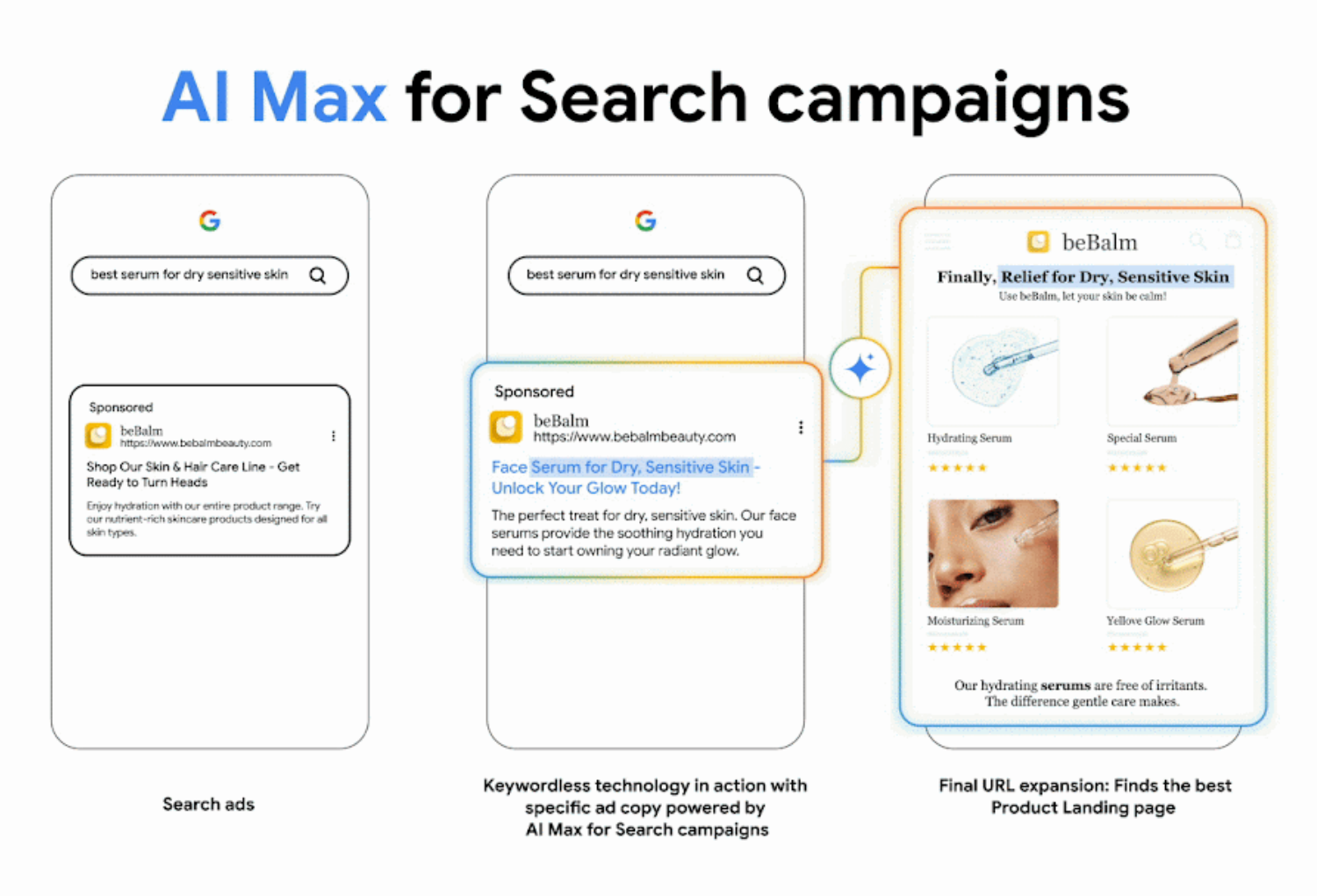
This gives the system more room to discover demand and adapt the ad experience. It also gives the advertiser less certainty about exactly which search, message and landing-page combination will be used before the auction. That is the central trade-off.
The early performance data is mixed—and context matters
Independent data is useful because Google naturally has an incentive to highlight its own products. Smarter Ecommerce analysed more than 250 AI Max campaigns and found a median increase of roughly 13% in conversion value alongside a median increase of roughly 16% in CPA.
The limitation is important: the dataset covered retail and e-commerce campaigns, not a universal B2B benchmark. Performance varied substantially between accounts. Early B2B SaaS case studies also describe AI Max discovering many new queries while converting at a lower rate than exact and phrase match, with additional traffic often informational rather than commercially ready. These small datasets are not proof of a general rule; they show why testing matters more than blanket adoption.
What about ads inside AI Overviews?
As of September 17, 2026, existing ads can appear above or below AI Overviews across the 200+ markets where AI Overviews are available. Ads inside an AI Overview are more limited: Google currently supports them in English in selected markets including Australia, Canada, India, Singapore and the United States. Japan is not currently on that list.
Eligibility inside AI Overviews requires AI-powered targeting such as broad match on Search or keywordless targeting through products including AI Max. Advertisers cannot target AI Overview placements alone, and Google Ads does not provide separate placement reporting for them. For a Japanese-language campaign targeting Japan, “you need AI Max or you will miss AI Overview ads” is therefore not accurate today.
Was it a mistake to start conservatively?
We do not think so. We did not begin with exact and phrase match plus Maximize Clicks because Smart Bidding is unavailable to new accounts—Google states that Target CPA can be used without existing conversion history. We chose a controlled first phase because we wanted a baseline.
Before expanding the system’s freedom, we wanted to know which queries were appearing, what traffic cost, which searches reflected commercial intent, what happened on the landing page and which enquiries were relevant. Those observations provide something to compare against later.
A baseline is not automatically a scientific control group. If Maximize Clicks becomes Smart Bidding, exact and phrase match become Intent Match, and AI Max is enabled simultaneously, several variables change at once. Google’s dedicated AI Max experiments can split traffic and budget between a control and treatment, creating a cleaner comparison.
In B2B, the conversion signal may matter more than the bidding strategy
As automation becomes more sophisticated, operators make fewer individual bidding decisions. That makes another decision more important: what exactly are we teaching the system to optimise for?
If every form submission is the primary conversion, Google will optimise toward form submissions. But in B2B, a form submission and a qualified sales opportunity are not necessarily the same event. Google Ads supports deeper-funnel goals such as Qualified Leads and Converted Leads, using offline data to connect advertising activity with what happens later in sales.
The more freedom we give the algorithm, the more important it becomes to provide a success signal that reflects actual business value.
A healthier way to introduce automation
Control → Measurement → Test → Comparison → Optimization
First, make measurement reliable. Then understand what the current campaign produces. Introduce automation so that its effect is measurable—ideally changing one meaningful variable at a time or using an experiment. Compare more than traffic: conversions, CPA, qualified leads, search terms, on-site behaviour and, where possible, which leads become genuine sales opportunities.
If automation finds additional profitable demand, expand it. If it increases reach while degrading lead quality or acquisition efficiency, adjust it. The objective is not to prove Google right or wrong; it is to make a decision that your own data can explain.
Conclusion: automation does not remove campaign management—it moves it
Smart Bidding, Intent Match, AI Max and AI Overviews all point in the same direction: Google is taking a larger role in interpreting intent, context and conversion probability in real time. That change is real, but it does not eliminate strategy.
- Define the right conversion.
- Feed the system reliable signals.
- Monitor search terms and lead quality.
- Design experiments that isolate meaningful changes.
- Decide whether the output creates business value.
Automation is not replacing management. It is changing where management happens.